
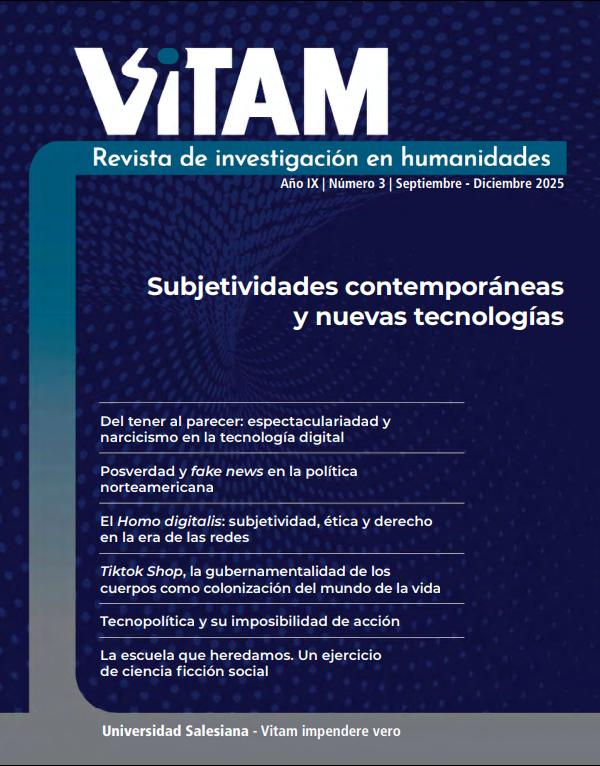
La Tecnopolítica y su imposibilidad de acción
Palabras clave:
tecnopolítica, triple revolución, tecnocolonialismo, bigtech, dependencia tecnológica, imaginarios sociotécnicosResumen
Este ensayo intenta analizar la influencia de la triple revolución en la configuración de un individualismo en red que transforma la vida social y política. Se analiza cómo estas tecnologías han posibilitado la emergencia de movimientos sociales y, al mismo tiempo, su cooptación por parte del capital corporativo y de gobiernos alineados con esos intereses. El concepto de tecnopolítica se contrasta con el de tecnocolonialismo, evidenciando la dependencia tecnológica del Sur Global frente al dominio de las bigtech. Asimismo, se identifican prácticas de control digital que restringen la acción política y moldean subjetividades. Se concluye que resulta urgente diseñar imaginarios sociotécnicos alternativos para contrarrestar la concentración de poder en las bigtech y recuperar el potencial emancipador de la tecnología.
Citas
Agamben, G. (2011). ¿Qué es el dispositivo? Sociológica, 26(73), 249–264. http://www.scielo.org.mx/scielo.php?script=sci_arttext&pid;=S0187-01732011000200010
Anguiano, E. (2022). La desinformación como instrumento de guerra en la era de la posverdad. Reflexiones Marginales, 69. https://reflexionesmarginales.com/blog/2022/05/25/la-desinformacion-como-instrumento-de-guerra-en-la-era-de-la-posverdad/
Baumeister, R. F., y Leary, M. R. (1995). The need to belong: Desire for interpersonal attachments as a fundamental human motivation. Psychological Bulletin, 117(3), 497–529. https://doi.org/10.1037/0033-2909.117.3.497
Carayannis, E. G., Barth, T. D., y Campbell, D. F. J. (2012). The quintuple helix innovation model: Global warming as a challenge and driver for innovation. Journal of Innovation and Entrepreneurship, 1(2), 1–12. https://doi.org/10.1186/2192-5372-1-2
Castells, M. (2012). Redes de indignación y esperanza. Alianza Editorial.
Chayko, M. (2014). Techno-social life: The Internet, digital technology, and social connectedness. Sociology Compass, 8(7), 976–991. https://doi.org/10.1111/soc4.12190
Edidin, B., Kochetkova, K., y Sarankina, N. (2024). Digital abuse: How dark patterns manipulate our lives. Legal Issues in the Digital Age, 5(4), 4–27. https://doi.org/10.17323/2713-2749.2024.4.4.27
Ekman, J., y Amnå, E. (2012). Political participation and civic engagement: Towards a new typology. Human Affairs, 22(3), 283–300. https://doi.org/10.2478/s13374-012-0024-1
Elliott, V. (2024, septiembre 24). Russia-backed media outlets are under fire in the US—but still trusted worldwide. WIRED. https://www.wired.com/story/russia-backed-media-ou tlets-are-under-fire-in-the-us-but-still-trusted-worldwide
Gorwa, R., Binns, R.,y Katzenbach, C. (2020). Algorithmic content moderation: Technical and political challenges in the automation of platform governance. Big Data & Society, 7(1), 1–15. https://doi.org/10.1177/2053951719897945
Hackbarth, K. (2024, 4 abril). La campaña para tachar de narco a AMLO. Jacobin Lat. https://jacobinlat.com/2024/04/la-campana-para-tachar-de-narco-a-amlo
Haugh, T., Stemler, A., y Perry, J. (2020). The code of the platform. Georgia Law Review, 54(2), 605–663. https://digitalcommons.law.uga.edu/glr/vol54/iss2/5
Heawood, J. (2018). Pseudo-public political speech: Democratic implications of the Cambridge Analytica scandal. Information Polity, 23(4), 429-434. https://doi.org/10.3233/IP-180009
Human Rights Watch. (2025, julio 30). Russia: Internet blocking, disruptions and increasing isolation. https://www.hrw.org/news/2025/07/30/russia-internet-blocking-disruptions-and-increasing-isolation
Imbong, R. A. (2023). Neocolonialism and the technopolitics of specialization: Toward a reimagination of the sociotechnical imaginaries approach. Bandung: Journal of the Global South, 10(2), 283–301. https://doi.org/10.1163/21983534-10020008
Jasanoff, S. (2015). Future imperfect: Science, technology, and the imaginations of modernity. En S. Jasanoff y S.-H. Kim (Eds.), Dreamscapes of modernity: Sociotechnical imaginaries and the fabrication of power (pp. 1–33). University of Chicago Press.
Jin, S. (2022). Anti-monopoly regulation of digital platforms. Social Sciences in China, 43(1), 70–87. https://doi.org/10.1080/02529203.2022.2051357
Kidd, D., y McIntosh, K. (2016). Social media and social movements. Sociology Compass, 10*(9), 785–794. https://doi.org/10.1111/soc4.12399
Kurban, C., Peña-López, I., y Haberer, M. (2017). What is technopolitics? A conceptual schema for understanding politics in the digital age. IDP. Revista de Internet, Derecho y Política, (24), 3-20. https://www.redalyc.org/articulo.oa?id=78850913002
Langman, L. (2005). From virtual public spheres to global justice: A critical theory of internetworked social movements. Sociological Theory, 23(1), 42–74. https://doi.org/10.1111/j.0735-2751.2005.00242.x
Latour, B. (2005). Reensamblar lo social: Una introducción a la teoría del actor-red. Manantial.
Lupu, N., Ramírez, M., y Zechmeister, E. (2020). Social media disruption: Messaging mistrust in Latin America. Journal of Democracy, 31(3), 160–171. https://doi.org/10.1353/jod.2020.0038
Padilla, J., Piccolo, S., y Vasconcelos, H. (2022). Business models, consumer data and privacy in platform markets. Journal of Industrial and Business Economics, 49, 599–634. https://doi.org/10.1007/s40812-022-00218-0
Pfaffenroth, S., y Tabas, M. (2022). Impact of digital market regulation to be felt on both sides of the Atlantic. Competition Law & Policy Debate, 7(3), 137–142. https://doi.org/10.4337/clpd.2022.03.05
Postmes, T., Russell, A., Sakhel, K., & de Groot, D. (2001). Social influence in computer-mediated communication: The effects of anonymity on group behavior. Personality and Social Psychology Bulletin, 27(10), 1243–1254. https://doi.org/10.1177/01461672012710001
Rainie, L., y Wellman, B. (2012). Networked: The new operating system. MIT Press.
Ricaurte, P., Gómez-Cruz, E., y Siles, I. (2024). Algorithmic governmentality in Latin America: Sociotechnical imaginaries, neocolonial soft power, and authoritarianism. Big Data & Society, 11(1). https://doi.org/10.1177/20539517241229697
Savolainen, L. (2022). The shadow banning controversy: Perceived governance and algorithmic folklore. Media, Culture & Society, 44(6), 1091–1109. https://doi.org/10.1177/01634437221077174
Schlag, G. (2023). European Union's regulating of social media: A discourse analysis of the Digital Services Act. Politics and Governance, 11(3), 168–177. https://doi.org/10.17645/pag.v11i3.6735
Srnicek, N. (2017). Platform capitalism. Polity Press.
Sombatpoonsiri, J. (2025, 30 septiembre). The promises and pitfalls of the social media–fueled Gen-Z protests across Asia. Carnegie Endowment for International Peace. https://carnegieendowment.org/emissary/2025/09/social-media-gen-z-protests-nepal-indonesia-promises-pitfalls
Sputnik Mundo. (2022, 21 octubre). Quiénes son los ‘outsiders’ que buscan su lugar en la política latinoamericana. NoticiasLatam. https://noticiaslatam.lat/20221021/quienes-son-los-outsiders-que-buscan-su-lugar-en-la-politica-latinoamericana-1131706021.html
Twine, F. W. (2018). Technology's invisible women: Black geek girls in Silicon Valley and the failure of diversity initiatives. International Journal of Critical Diversity Studies, 1(1), 58–79. https://doi.org/10.13169/intecritdivestud.1.1.0058
Waldman, A. E. (2020). Cognitive biases, dark patterns, and the “privacy paradox”. Current Opinion in Psychology, 31, 105–109. https://doi.org/10.1016/j.copsyc.2019.08.025
Descargas
Publicado
Cómo citar
Número
Sección
Categorías
Licencia
Derechos de autor 2026 Vitam. Revista de Investigación en Humanidades

Esta obra está bajo una licencia internacional Creative Commons Atribución-NoComercial-SinDerivadas 4.0.


